Preserving Art in Times of War
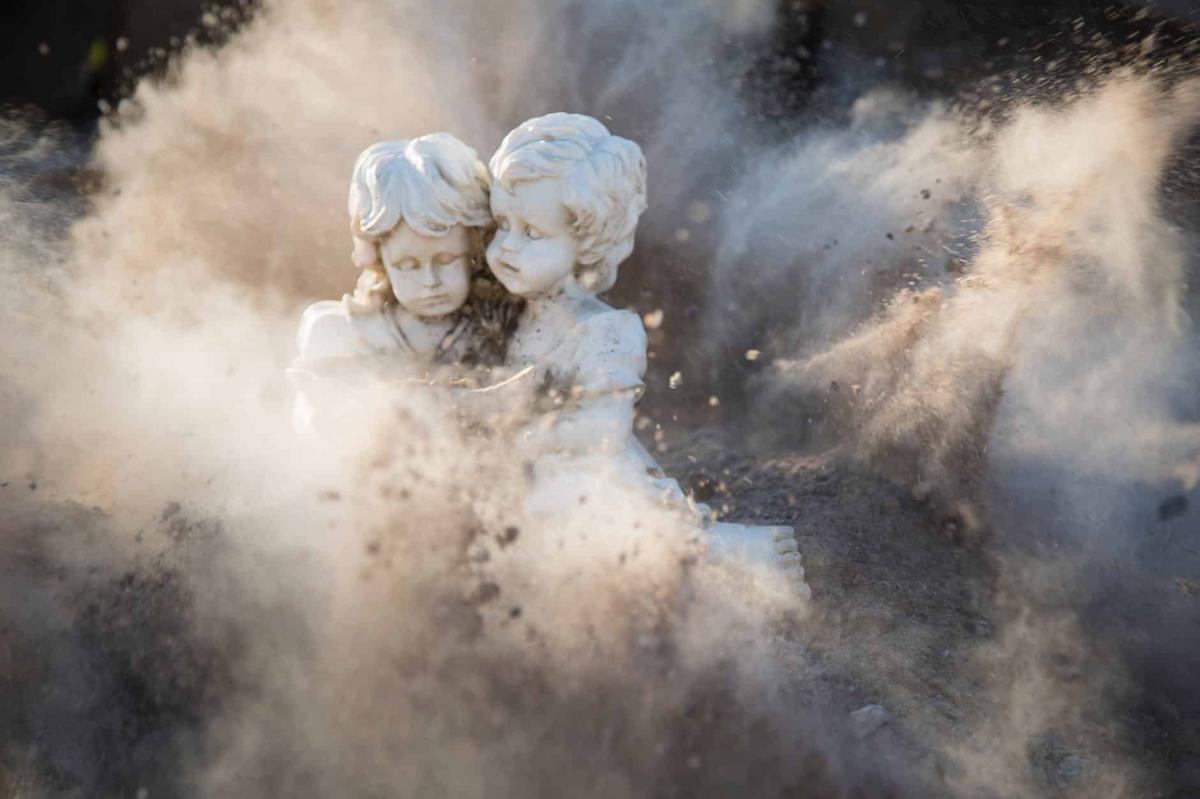
Bombs not only destroy cities and people, but also culture and history. New histories are written to the shame of humanity. The destruction of cultural heritage also erases peoples and their histories.
However, societies exist with their histories. Every cultural heritage is important in terms of carrying the history of societies to the present and the future. Therefore, the destruction of cultural property in the event of armed conflict is considered a violation of international law.
Despite this, Russia’s invasion of Ukraine is also discussed with the destruction of cultural assets.
Chernihiv is a city on the brink of humanitarian disaster. There is no electricity for the local population. They also lack safe escape routes. Russian missiles destroyed the Vasyl Tarnovskyi Museum. The whereabouts of the museum’s collection is not yet known.
In Mariupol, Russian soldiers bombed the mosque of Suleiman the Magnificent and his wife Roksolana. More than 80 people were in the mosque, 34 of them children. They also destroyed the Donetsk Drama Theater. The theater sheltered more than a thousand women. It also sheltered children. This was despite the word ‘children’ being written in Russian outside the building. The word was visible from the sky.
Ukraine has seven Unesco World Heritage-listed sites. There are also many monuments and countless other cultural treasures. Much in Ukraine is at risk of destruction.
The loss of cultural heritage and objects is one of the numerous atrocities of war.
Of course, this is not the first war in which the world that cultural heritage has been damaged. In recent years we have witnessed the tragic destruction of six Unesco World Heritage-listed sites in Syria. Our recent history is full of similar tragedies for humanity.
The Great Nazi Loot
Adolf Hitler was an unsuccessful artist who was not accepted into the Vienna Academy of Fine Arts. However, he considered himself a connoisseur of art. When he became Chancellor of Germany in 1933, he set about applying his aesthetic ideal to the nation.
He called modern art ‘degenerate art’ and decided to sell or destroy such works in Germany’s state museums. In turn, he began collecting (looting) works of art from other countries.
Propaganda Minister Joseph Goebbels called Germany’s corrupt artists “garbage” in a radio broadcast he attended.
Even before the Second World War began, Hitler embarked on the world’s largest art loot to open his own museum of classical art in Linz, Austria.
Hitler had a passion for power that affected his attitude towards art and science. He wanted to steal their cultural heritage. His aim was to prove his superiority over the other countries he occupied. He thought that owning valuable works of art would strengthen him. These works of art showed the traditions, history, and cultural accumulation of their societies.
England, for example, decided to store the country’s artworks in a mine in North Wales. This decision was made by Churchill. The country was discussing sending the artworks to Canada in case of Hitler’s possible invasion.
In response to the same threat in Turkey, President İsmet İnönü secretly ordered the protection of sacred relics and works of art. Especially those in the Topkapı Palace were sent to Niğde. They were protected with 391 ballot boxes. This unique cultural heritage was secretly hidden here until the end of the war.
‘Monuments Men’
In response to the Nazi plunder, World War II, an international group was formed to help preserve cultural assets during and after the war.
American and British operations organized the efforts. This group of museum curators, art historians, architects, and even artists from fourteen nations actively identified and located artworks. They found archives and other cultural resources destroyed by German forces.
When this group, known (and also filmed) as the Monuments Men, left Europe in 1951, they found and repatriated nearly four million stolen objects.
Art is the unfinished business of World War II.
The Allies recovered a large number of stolen paintings in the salt mines near Salzburg and in a castle south of Munich. However, an unknown number of these paintings were also destroyed.
Although decades have passed, there are still hundreds of thousands of works of art that were lost at that time.
In 2021, a raid on a house in Munich on suspicion of tax evasion found 1,406 paintings and drawings. These works found in Cornelius Gurlitt’s apartment were the works kept by his father Hildebrand Gurlitt, who was selling art looted by the Nazis.
Five years ago, Austria announced the existence of 10,000 paintings and sculptures. These artworks were hidden in a monastery on the banks of the Danube and in some government institutions since 1945.
History keeps repeating!
Tragedies in world history are not lessons for humanity. The same dramas happen over and over again.
Russia, whose cultural heritage was plundered by the Germans years ago, is doing the same to Ukraine today. In Ukraine, there is a war to protect life and cultural heritage on the other.
Across Ukraine, artists, gallerists, curators, and museum directors are desperately trying to protect their country’s cultural heritage. Local people are also wrapping, hiding, and safeguarding these treasures.
Statues, stained glass windows and monuments are covered with shrapnel-proof materials. Paintings and all portable artifacts are lowered into basements and bunkers.
The people are fighting to protect their lives. They are also in a relentless struggle to safeguard the cultural and artistic heritage of their society.
The world, on the other hand, still seems not to have learned from the past. This is evident in the face of one-man tragedies. These tragedies are created by psychopaths who seized power.
#STOPWAR
Sources:
https://theworld.org/stories/2011-04-18/soldiers-protecting-art-art-protecting-soldiers
https://inkstickmedia.com/protecting-ukraines-culture-during-war-time/
https://www.metmuseum.org/about-the-met/provenance-research-resources/monuments-men
https://www.washingtonpost.com/world/2022/03/14/ukraine-odessa-russia-war/
https://www.rferl.org/a/lviv-monuments-protection-russia-war/31759566.html
https://www.sozcu.com.tr/2014/yazarlar/soner-yalcin/391-sandik-hazine-478171/
İlgili yazılar
 Sürdürülebilirlik Eleştirisi · 21 May 2026
Şirketler ne satar? Ürün mü, güven mi?
Uzun süre ekonominin mantığı basitti. Üreten kazanırdı. Değer somuttu. Tonla, kilowatt-saatte, adet başına maliyetle ölçülürdü. Pek, ya bugün?
 Sürdürülebilirlik Eleştirisi · 1 Eki 2025
Sustainability: The Corporate Challenge Ahead
CEOs pledge sustainability, but fail to prepare for it.
 Sürdürülebilirlik Eleştirisi · 16 Nis 2025
Embracing Abundance: A New Economic Perspective
Ezra Klein presents a hopeful vision of abundance based on ethical values, emphasizing qualitative prosperity. True abundance requires an eco-social transformation that values sustainability, human dignity, and social justice.